Processing Order and Precedence within a GPO
Within a particular GPO (Computer or User side), the processing order is counted in numerical order. So lower-numbered collections attempt to process first, and higher-numbered collections attempt to process last. Then, within any collection, each policy is processed in numerical order from lowest to highest.
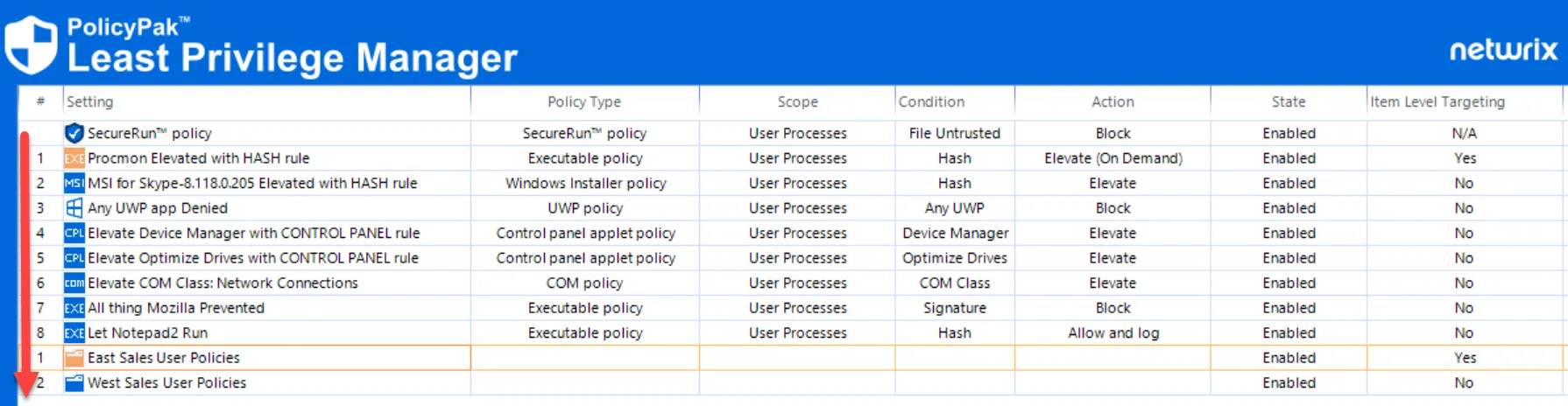
Within any collection, each policy is processed in numerical order from lowest to highest.
Policies can be delivered by Group Policy and non-Group Policy methods, such as Microsoft Endpoint Manager (SCCM and Intune) via PolicyPak Exporter or PolicyPak Cloud. As such, the PolicyPak engine needs to make a final determination whether there is any overlap of policies. Here is how the precedence works:
- Policies delivered through PolicyPak Cloud have the lowest precedence.
- Policies delivered through PolicyPak files have the next highest precedence.
- Policies delivered through PolicyPak Group Policy directives have the highest precedence.
After that, user-side policy has precedence over computer-side (Switched) policy. This occurs in order to specify a baseline setting for various computers. Then, specific (overriding) policies can be used when specific users log on. If SecureRun™ is enabled and performs work (i.e., blocking processes), then user-created processes aren’t created unless expressly allowed with the Allow and log rule. At this point, each rule is applied one by one to perform elevation (or Block or Allow and log).