Troubleshoot the Remote Access Gateway
Use this page when users can't sign in to the portal, the portal doesn't load, or a session doesn't open. Each entry gives the symptom, the cause, and the fix.
Log files
| Component | Log | Location |
|---|---|---|
| Gateway | PAM-RagGateway*.log | C:\ProgramData\Stealthbits\PAM\Log |
| Portal | PAM-RagPortal*.log | C:\ProgramData\Stealthbits\PAM\Log |
| Portal web server (nginx) | nginx-access.log | C:\ProgramData\Stealthbits\PAM\Log |
| Apache Guacamole daemon (guacd) | Output of docker logs <container> | Inside Windows Subsystem for Linux (WSL) on the gateway server |
The gateway log is empty until the gateway receives its first request. The portal log also holds the nginx error output.
To find the guacd container name, run docker ps inside WSL. For the logs of the other Privilege Secure services, see Log files.
The sign-in page says the license has expired
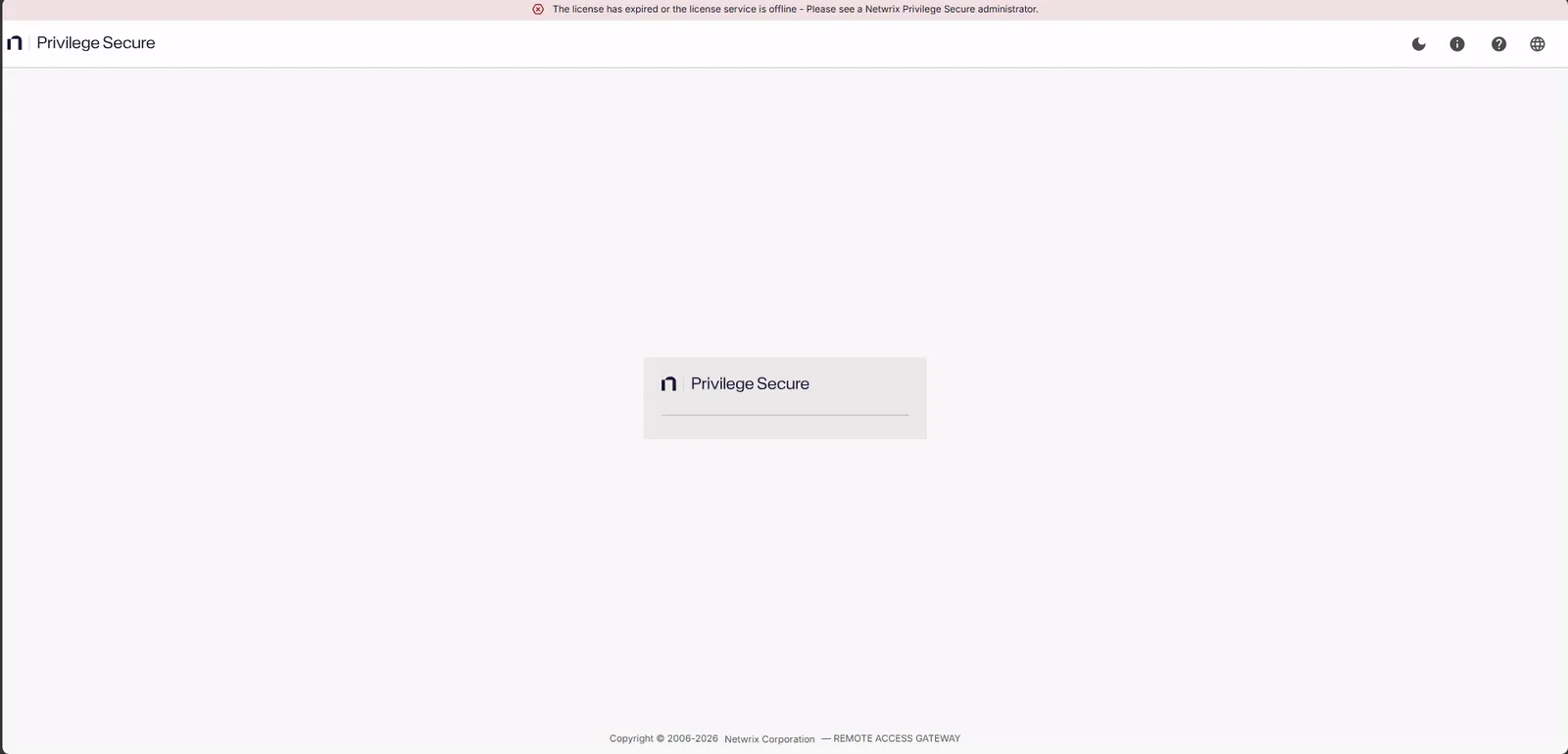
Symptom: The sign-in page shows the banner "The license has expired or the license service is offline".
Cause: The Privilege Secure license is expired, isn't valid, or the license service isn't running. The portal reads the license state from Privilege Secure.
Fix: Correct the license in the Privilege Secure console. See Activate a license.
A user belongs to no access policy
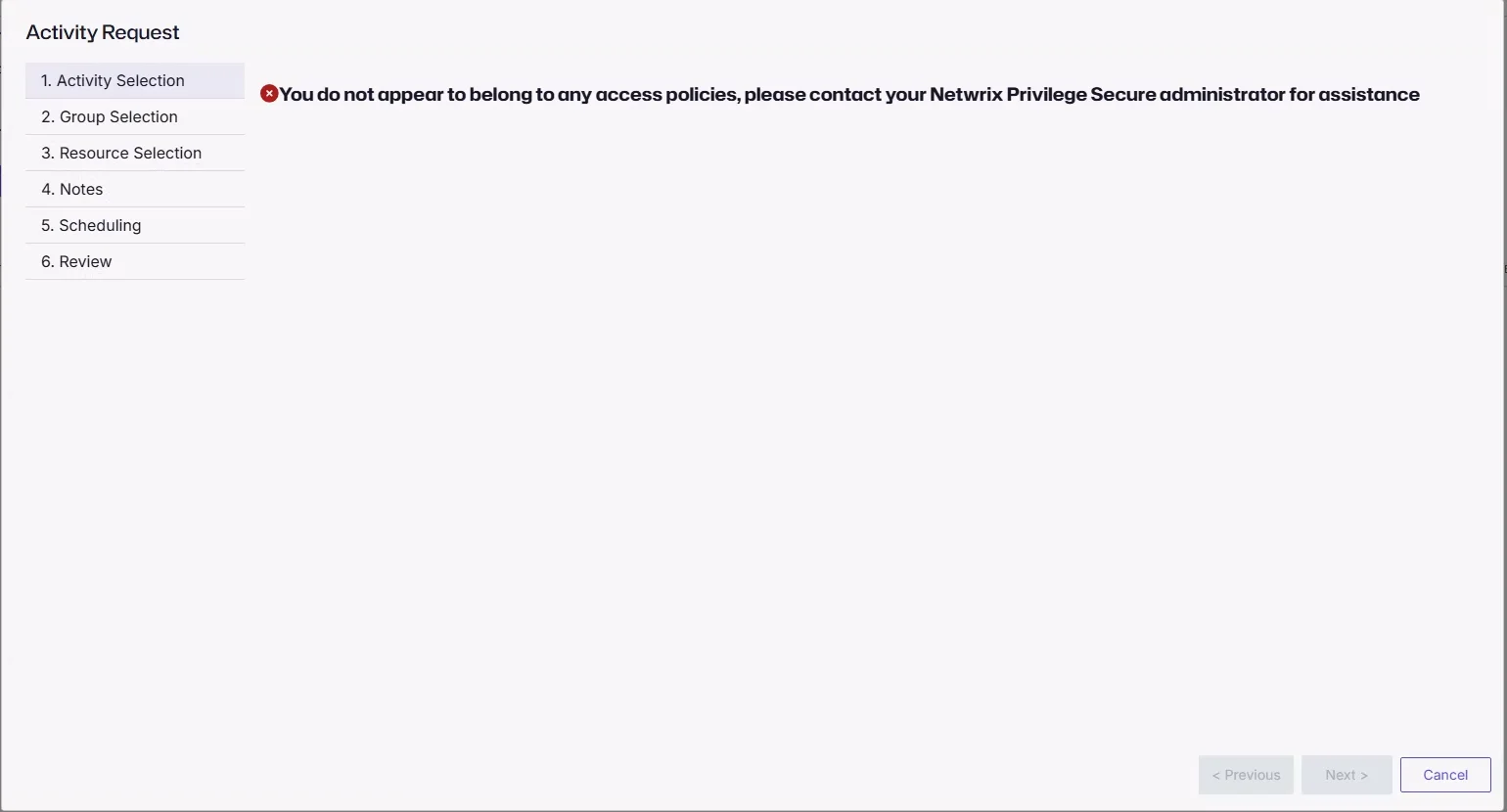
Symptom: The Activity Request wizard shows "You do not appear to belong to any access policies, please contact your Netwrix Privilege Secure administrator for assistance".
Cause: The user isn't a member of any access policy.
Fix: Add the user to an access policy that includes the activity and the resource. See Access policies.
The sign-in page rejects the login method
Symptom: The sign-in page rejects the user with "Cannot use this login method".
Cause: The AllowedLoginMethods setting doesn't allow the method. The default value, 0, allows single sign-on (SSO) only. With value 1, the portal also rejects a username that contains \ or @.
Fix: Ask the user to use an allowed method, or change the setting. See Configure sign-in for the Remote Access Gateway portal.
A connector can't be used through the gateway
Symptom: The identity provider sign-in option isn't listed on the portal sign-in page. If a user reaches the sign-in through a direct link or a callback from the identity provider, the sign-in fails. The error reads "This authentication method cannot be used via Remote Access Gateway". The Privilege Secure log and event show the longer message, with the name of the connector: "The authentication method: '<name>' cannot be used via Remote Access Gateway".
Cause: The connector doesn't match where the user signs in. A connector with Use Remote Access Gateway selected works only through the portal, and fails on the console. A connector with the checkbox cleared works only on the console, and fails through the portal.
Fix: To offer the identity provider on the portal, edit the connector, or create one for the portal, and select Use Remote Access Gateway. To offer it on both the portal and the console, create one connector for each. See Configure sign-in for the Remote Access Gateway portal.
ERRCONNECT_LOGON_FAILURE after you enter the target password

Symptom: The Live Sessions page shows "ERRCONNECT_LOGON_FAILURE" and "Failed to connect to target server. Logon failed."
Cause: The target rejected the sign-in. Check these causes:
- Wrong password. The password isn't the one for the account that the activity uses on the target.
- Wrong account type. The activity uses the Requester login account, and the user signed in to the portal with a local Privilege Secure user. The target receives that username, and a domain-joined Windows target might not have such an account. Sign in with a domain user, or ask the administrator to use a different login account on the activity.
Fix: Enter the correct password, or fix the login account. The prompt takes only a password, so you can't enter a different username at connect time.
The portal refuses to connect while the service is running
Symptom: The browser reports that the portal "refused to connect". The NPS Rag Portal service shows Running.
Cause: nginx can't bind port 80, and the service keeps restarting it. Another program, usually the IIS Default Web Site, uses port 80. The portal log shows this line:
bind() to 0.0.0.0:80 failed (10013: An attempt was made to access a socket in a way forbidden by its access permissions)
Fix: Install the portal on a dedicated server with ports 80 and 443 free. See Remote Access Gateway requirements.
The portal returns a 502 error or a blank page
Symptom: The portal loads but returns a 502 error or a blank page.
Cause: The portal can't reach the gateway on port 6550. Check these causes:
- The IIS site NPS Gateway Web Service on the gateway server is stopped.
- A firewall blocks port 6550 between the portal server and the gateway server.
- The nginx upstream still holds the placeholder
nps-gatewayhostbecauseConfigure-Nginx.ps1didn't run.
Fix: Start the IIS site, open port 6550, or run Configure-Nginx.ps1 <gateway-server> on the portal server. See Install the Remote Access Gateway portal.
The gateway runs with default settings
Symptom: Sessions fail. appsettings.json doesn't exist in C:\ProgramData\Stealthbits\PAM\RagGateway, or NPS.Uri points to localhost and Guacd.ServerThumbprint holds "Guacd:ServerThumbprint not set!". For the file location, see Gateway settings reference.
Cause: Configure-Gateway.ps1 didn't finish. The script exits without applying your values when it can't reach Privilege Secure or guacd on port 4822. If it can't reach Privilege Secure, appsettings.json might not exist. If it can't reach guacd, the file holds only the defaults.
Fix: Confirm that the gateway server can reach the Privilege Secure URL. Start guacd, and confirm that it listens on port 4822. Then run Configure-Gateway.ps1 again. See Install the gateway and guacd.
A session closes or stays blank as soon as it opens
Symptom: A session closes, or the page stays blank, right after it opens. The guacd log might show "wrong security type?", or the gateway log might show "One time use token ... not found or revoked".
Cause: One of these causes applies:
- The RDP Proxy (host:port) or SSH Proxy (host:port) value on the connection profile of the access policy is set to
localhost, or guacd can't reach it. From inside the guacd container,localhostis the container, not the Privilege Secure server. - The one-time token for the session expired or was revoked.
Fix: Set the proxy host to an address that guacd can reach, and then start the session again from the dashboard.
The gateway reports a certificate thumbprint mismatch
Symptom: The gateway log shows "Certificate thumbprint mismatch" when a session starts.
Cause: The guacd certificate changed after the gateway stored its thumbprint.
Fix: Run Configure-Gateway.ps1 again so that it stores the new thumbprint. See Portal and gateway certificates.
Sessions fail after the server restarts
Symptom: Users sign in to the portal and request sessions, but the sessions don't open after the gateway server restarts.
Cause: WSL stopped, so guacd is down. WSL doesn't start by itself after a restart, and it stops when it is idle.
Fix:
- On the gateway server, run
wsl -l -vin PowerShell. Confirm that the distribution shows Running. If it shows Stopped, runwslto start it. - In the Ubuntu distribution, run
sudo docker ps. The output lists a container namedguacdthat publishes port 4822. Ifguacdisn't listed, runsudo docker start guacd. - In PowerShell, run
Test-NetConnection <guacd-host> -Port 4822and confirm thatTcpTestSucceededisTrue.
If the address of the WSL instance changed, run wsl hostname -I to get the current address. Then run Configure-Gateway.ps1 again with that address as the -NPSGuacdHost value.
The installer registers two scheduled tasks, NPS WSL holder and NPS WSL net keepalive, that run at startup and keep WSL and guacd up without a manual wsl command. Keep both tasks enabled. If guacd still becomes unreachable, restart the container: run wsl -d Ubuntu -u root -- docker restart guacd, then repeat the port 4822 connection check in step 3. For the task details, see Start WSL automatically.
Colors look wrong in an RDP session
Symptom: Colors in an RDP session look wrong, such as red and blue swapped.
Cause: A guacd version that doesn't match the portal can cause this. Release 26.07.3 requires guacd 1.6.0. For RDP sessions, the portal swaps the red and blue channels in the browser to match how guacd 1.6.0 draws them.
Fix: In WSL, run docker ps and confirm that the guacd image is exactly guacamole/guacd:1.6.0. If it isn't, upgrade guacd. See Upgrade the Remote Access Gateway.
The portal applies the color swap only for RDP sessions, and only when the application server setting Client:ColorChannelSwap is true. The setting is true by default. To turn the filter off, set it to false in the application server's appsettings.json, then recycle the SbPAMAppPool application pool.
Keyboard or pointer behaves oddly in an RDP session
Symptom: Some keys don't type what you expect in an RDP session. The numeric keypad, AltGr, or
characters that need a key combination may do nothing or produce the wrong character. The pointer can also
look larger than usual or sit slightly away from the click point.
Cause: The portal uses the standard Guacamole keyboard and mouse handlers, and guacd draws the session. The browser decides whether it captures special keys, and guacd decides how the target sees them. The target's own keyboard layout and pointer size also apply.
Fix: Check these in order:
- Click inside the session display so the canvas has focus, then try the key again.
- Set the target's keyboard layout to match yours.
- If the numeric keypad doesn't work, turn on Num Lock on your keyboard. Browsers send these keys only with Num Lock on.
- If a key combination is captured by the browser or the operating system, use the Ctrl+Alt+Delete button in the session toolbar for that combination.
- If the pointer is large, change the pointer size on the target. The target sends the pointer image and guacd draws it, so the portal can't shrink it.